- Home
- Gifts of the Holy Spirit
- Gift of Tongues
The Gift of Tongues: Your Complete Guide for Believers
By Don Bell / Kingdom Anointing
Welcome to our comprehensive series on the Gift of Tongues! Whether you're exploring tongues for the first time or seeking deeper understanding, we'll delve into how speaking in tongues can revolutionize your prayer life, strengthen your faith, and equip you for ministering to others.
While believers across denominations may differ on some aspects of this gift, Scripture clearly presents tongues as valuable for those who receive it. Get ready to explore detailed guides such as "How to Speak in Tongues" and "How Are Tongues a Sign for Unbelievers," and examine the question "Did Jesus Speak in Tongues?" to further enrich your journey.
What Is the Gift of Tongues? A Clear Biblical Definition
 The Gift of Speaking in Unknown Tongues
(Source: ©Depositphotos.com)
Exactly what is the gift of speaking in tongues? Here's a biblical definition of this extraordinary gift of the Holy Spirit:
The gift of tongues is the God-given ability to speak at will in unknown heavenly languages without having studied them and without having a natural understanding of the words being spoken.
The Supernatural Nature of Tongues as Heavenly Languages
It's important to note that whenever the New Testament makes a reference to speaking or praying in tongues, it refers to speaking in different languages. These languages are structured, fluent, supernatural manifestations of the Holy Spirit.
When Paul says, "Though I speak with the tongues of men and of angels, ..." (1 Corinthians 13:1), he's implying that tongues are heavenly languages that he had not learned through conventional means. The Greek word γλῶσσα (glōssa) is translated as "tongues," meaning by implication, "languages" or "glossolalia."
7 Common Misconceptions About Speaking in Tongues
Understanding the true nature of the gift of tongues empowers us to use it effectively. Let's explore what distinguishes genuine tongues from common misconceptions:
- It is not the natural ability to speak and understand learned languages.
- It is not speaking gibberish or making strange, repetitive noises.
- It is not the product of our human intellect or emotionalism.
- It is not a forced or manipulated tongue — you remain in full control.
- It is not separate from praying in tongues; they are the same gift.
- It is not speaking in one tongue; it's speaking in multiple tongues.
- It is not the only evidence of the baptism with the Holy Spirit.
Clearing up misconceptions and gaining a solid understanding of the gift of tongues helps you use the gift effectively. You'll be able to edify yourself by communicating with God in your heavenly languages at any time.
You'll also be able to edify other believers in the Church by confidently delivering an inspired message in an unknown tongue that you can then interpret using the gift of interpretation of tongues.
Paul's Perspective: Natural Languages vs. Spiritual Tongues
Paul the Apostle was known to be fluent in several languages. He was raised speaking Koine Greek in Tarsus, where Greek culture and learning were prominent. He later studied the Hebrew Scriptures in Jerusalem under Gamaliel the Elder, and he would have spoken Aramaic while in Palestine and regions to the east.
However, whenever Paul mentions "tongues" in his writings, he is not referring to one of the languages he had learned, but supernatural tongues inspired by the Holy Spirit.
Paul explains, "For he who speaks in a tongue does not speak to men but to God, for no one understands him; however, in the spirit he speaks mysteries" (1 Corinthians 14:2); also, "For if I pray in a tongue, my spirit prays, but my understanding is unfruitful" (1 Corinthians 14:14).
When you speak in tongues, your mind cannot grasp the meaning of the sounds, syllables, and words that are said. You can have no understanding of a language that you've never learned or heard spoken before.
What's more, we're not just given one tongue but many tongues. As we explored earlier regarding the tongues of men and angels, with an estimated 7,159 human languages being spoken on Earth,1 you can only imagine the multitude of angelic tongues spoken in the Kingdom of Heaven!
Addressing the Gibberish Objection
Some well-meaning people have dismissed the gift of speaking in tongues as simply gibberish, saying it's just made-up sounds. However, any natural language can also sound like gibberish if you're totally unfamiliar with it.
A Personal Anecdote
During mission trips to St. Petersburg, Russia, my wife and I had to rely on our translator Irina during the day, but in the evenings we were on our own at the Hotel Oktiabrskaya and while discovering eating places along Nevsky Prospekt.
We had learned a few Russian phrases beforehand, but we were by no means fluent and struggled to understand the Russian spoken by hotel and restaurant staff. They effortlessly understood their language because of their familiarity with it, but to us, it often sounded like gibberish.
Speaking in unknown tongues requires an act of faith, and it cannot be compared to learning a natural language. Tongues bypass the understanding of the mind and to the uninitiated ear can sound similar to foreign languages.
How Tongues Work: A Spirit-to-Spirit Connection Explained
The following drawing illustrates my understanding of what happens when you step out in faith and supernaturally speak in an unknown tongue.
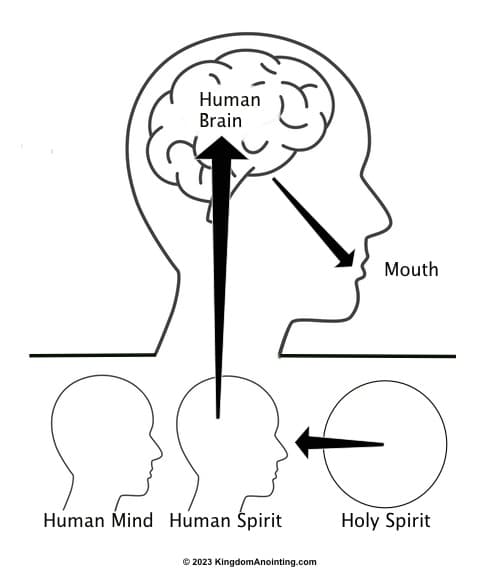 The Process of Speaking in Unknown Tongues
© 2023 KingdomAnointing.com
When a believer speaks in an unknown tongue, the Holy Spirit communicates with their spirit, which in turn instructs their brain to speak words of an unknown spiritual language as the Holy Spirit supplies them.
This spiritual language is one the person has never heard before, so their mind has no understanding of the words being formed on their tongue. Similarly, listeners also have no understanding of the words being spoken because it's a spiritual language they have not heard before either.
An important truth to understand: when you speak in tongues, you remain in complete control. You can start and stop at will, speak loudly or quietly, and choose when and where to pray in the Spirit. The Holy Spirit never overrides your will or forces you to do anything.
Paul teaches: "the spirits of prophets are subject to the prophets" (1 Corinthians 14:32). This means you're always in the driver's seat — the Holy Spirit supplies the language, but you choose whether to speak it. This is why speaking in tongues requires an act of faith on your part; it's a cooperative work between you and the Holy Spirit, not a passive experience where you lose awareness or control.
The Divine Communication Channel
The gift of speaking in tongues offers a form of private communication between the individual and God. You could call it a direct line!
The words spoken in tongues are intended for God's understanding alone. They are called "mysteries" by Paul (1 Corinthians 14:2). The one speaking in an unknown tongue is not meant to understand the words being spoken, just as no one else is meant to understand them.
Paul teaches that "the Spirit Himself makes intercession for us with groanings which cannot be uttered" (Romans 8:26). This concept of Spirit-led intercession links directly to the question we will address later: did Jesus speak in tongues?
What readers are saying
"I spent years reading books, going to conferences but nothing happened. I was at my last straw the other night and I just prayed and asked God for a picture that would explain the process [of speaking in tongues], and low and behold I clicked on your link and there was the picture I needed to understand the process.
"The words that I have spoken in my dreams are now spoken while I'm awake!!! Praise God for a picture and an explanation that a child can understand." —M., U.S.A.
The 3 Divine Purposes and Manifestations of Tongues
The Scriptures reveal three manifestations of tongues, each an expression of God's grace, and each serving a specific purpose to edify ourselves, the Body of Christ (the community of believers), and the unbelievers or uninformed.
It's important to understand that these three manifestations all flow from the same gift of tongues — it's not three different gifts, but one gift operating in three distinct contexts. Think of it like water from the same spring: when you drink privately from that spring, it refreshes you personally; when that same water flows into a gathering, it refreshes the community. The gift remains the same; only the setting and purpose change.
Whether you're praying quietly in your prayer closet or delivering a message in a church service, the Holy Spirit is the source, and the supernatural language is the same. The difference lies in how and when the Holy Spirit prompts you to use it.
Strengthening the Individual
When believers spend time praying in tongues privately, they commune with God and their prayer always reflects His perfect will. Inner healing, stronger faith, and blessings result. In fact, private prayer in tongues is a key component in strengthening our faith (Jude 20).
Strengthening the Church
When the Holy Spirit prompts a believer to speak a message in an unknown tongue in a public setting, He then prompts that same person to immediately give its interpretation so the Body of Christ is edified and encouraged to worship.
A Sign to Unbelievers and the Uninformed
Paul says, "Tongues are for a sign, not to those who believe but to unbelievers" (1 Corinthians 14:22). Tongues spoken by believers when prompted by the Holy Spirit can serve as divine evidence, leading nonbelievers and the uninformed to God's truth.
The manifestation at Pentecost is the ultimate example of tongues serving as a sign for unbelievers, a topic which we'll explore in greater detail later, including its connection to the Tower of Babel and God's Kingdom.
Personal Edification: The Primary Purpose of Tongues
 God Has a Purpose for Us Speaking or Praying in Tongues
(Source: ©shyrokowa/Depositphotos.com)
Why Speaking in Tongues Builds Your Faith
Edification
The Greek word οἰκοδομή (oikodomē) is translated as "edification," meaning to build up and promote growth in oneself and others.
Have you ever wondered why we should speak in an unknown tongue when we cannot understand its meaning? And, why Paul would declare, "I thank my God I speak with tongues more than you all" (1 Corinthians 14:18)?
Paul offers us insight by saying, "He who speaks in a tongue edifies himself" (1 Corinthians 14:4). Did you know that the gift of tongues is the only gift of the Holy Spirit that's specifically given to edify ourselves? The other gifts of the Spirit are all designed to edify and bless others.
Paul's dedication to tongues invites us to explore its rich significance and potential in our own spiritual journey. The gift of tongues could be considered the greatest gift for individual believers because it enables self-edification, the strengthening of faith.
That's partly because speaking in an unknown tongue requires an act of faith each time it's practiced. By exercising our faith in this way, we can increase and strengthen the measure we have.
How Tongues Prepares You for Other Gifts of the Spirit
To excel in the gifts of the Spirit and effectively minister to others, it is crucial that we build up our faith through praying in the Holy Spirit (praying in tongues) as Jude encourages, "But you, beloved, building yourselves up on your most holy faith, praying in the Holy Spirit, keep yourselves in the love of God" (Jude 20–21).
This might help to explain why tongues is so often the first gift to manifest after receiving the baptism with the Holy Spirit, a spiritual empowerment distinct from water baptism. As we actively exercise our supernatural prayer ability, our faith increases, enabling us to exercise other gifts of the Spirit and minister to others.
Therefore, the gift of tongues plays a significant role in strengthening our faith and keeping us grounded in Christ. After all, we need to be full of faith to accomplish God's plan for our lives and to reveal His Kingdom to a waiting world.
The Results: Accessing Guidance and Power
Praying in tongues connects us to God in ways that go beyond what we can naturally understand. The Holy Spirit acts as a communication bridge between us and God, expressing our prayers according to God's perfect will (Romans 8:26–27). This spiritual connection helps us better align our lives with what God wants for us.
This supernatural form of prayer can lead to amazing results in our lives. It often creates unexpected opportunities, brings us into divinely arranged meetings with others, and allows us to experience God's presence in remarkable ways.
A Personal Anecdote
My wife and I flew to Russia twice on mission trips taking medications, clothing, and children's toys to needy orphanages. It's noteworthy that we had never prayed about going to Russia or had any connections with Russia prior to these trips. Russia wasn't a country we had ever considered visiting.
Nonetheless, God orchestrated this opportunity for us, presenting His plan to each of us independent of the other over several weeks, and it was only when we later shared the Holy Spirit's promptings with each other that we understood His will.
I'm certain that our regular praying in tongues played a significant role in preparing us to be receptive to His will and guidance. Also, during those mission trips, I often prayed in tongues for direction, and the Holy Spirit guided our steps in remarkable ways.
From Prayer to Ministry: The Overflow Effect
As we engage in tongues, we receive guidance and strength from the Holy Spirit. This empowerment helps us fulfill our role to share the gospel more effectively to those around us. When you pray in the Spirit and build up your faith, people in need will be drawn to you, attracted by God's anointing within you and the rivers of life flowing through you.
You'll start to find yourself praying more effectively with signs following and begin to identify with Paul when he says, "I ... did not come with excellence of speech or of wisdom declaring to you the testimony of God ... but in demonstration of the Spirit and of power, that your faith should not be in the wisdom of men but in the power of God" (1 Corinthians 2:1–5).
Corporate Edification: Using Tongues to Strengthen the Church
While the gift of tongues is the only gift of the Spirit supplied for self-edification, the same gift is also supplied for group edification.
Paul explains, "Brethren, if I come to you speaking with tongues, what shall I profit you unless I speak to you either by revelation, by [a word of] knowledge, by prophesying, or by teaching? ... Therefore let him who speaks in a tongue pray that he may interpret" (1 Corinthians 14:6, 13, emphasis added).
When the Holy Spirit prompts a believer to speak a message in tongues to the Body of Christ during corporate worship, followed immediately by an interpretation of the tongue, all believers present can understand its meaning and be strengthened spiritually.
Is Tongues the Only Evidence of Holy Spirit Baptism?
While speaking in an unknown tongue offers immediate evidence of baptism with the Holy Spirit, it should NOT be considered the ONLY evidence.
A Personal Anecdote
My Christian friend received the baptism of the Holy Spirit and served as the president of our local chapter of the Full Gospel Business Men's Fellowship International (FGBMFI) for many years. Although he did not exercise the gift of in tongues, he clearly displayed a deep love for his Saviour, and he became proficient in other gifts of the Holy Spirit, particularly the gift of a word of knowledge.
Being a mechanic by trade, he gained a reputation for being successful at repairing broken-down trucks that other mechanics had given up on. It wasn't that he was a superior mechanic, though he excelled at his job. His secret was that he prayed over the vehicles, and the Holy Spirit gave him insights through words of knowledge (supernatural insights given by the Holy Spirit). He could envision exactly where the problems lay and the best way to repair them. And, surprisingly, he never spoke in tongues.
Multiple Evidences of Spirit Baptism
You may find yourself in a church that doesn't teach or practice the gift of tongues, and that's okay. Many sincere, Bible-believing churches hold different theological positions on spiritual gifts, with some teaching that certain gifts ceased after the apostolic age, while others simply emphasize different aspects of the Holy Spirit's work.
If you're in such a church, you can still honor your church leadership while privately pursuing the gifts of the Spirit in your personal prayer life. The gift of tongues is primarily for your private edification anyway, so you don't need to create division or controversy in your church community. Seek out Spirit-filled believers for fellowship and encouragement. Perhaps there's a prayer group, a Bible study, or Christian friends in your local area who share your hunger for the Spirit's fullness.
Remember, unity in the Body of Christ is precious, and we can maintain that unity while respectfully holding different convictions on matters not essential for salvation. What matters most is that we all love Jesus, honor His Word, and seek to be filled with His Spirit in whatever way He chooses to manifest in our lives.
There are other "evidences" of being filled with the Holy Spirit, such as manifesting other gifts of the Spirit, manifesting the fruits of the Spirit (love, joy, peace, and other godly character qualities described in Galatians 5:22–23), increased boldness in declaring God's Word, a greater love for the things of God, and so on. That said, the manifestation of tongues offers a clear and unmistakable evidence that should not be disregarded or downplayed.
The Role of Tongues in God's Plan for Today's Believer
Paul says, "I thank my God I speak with tongues more than you all" (1 Corinthians 14:18). This bold statement reveals Paul's reliance on the gift of tongues to build up his faith and sustain himself amid the sufferings he endures for the sake of the gospel.
He acknowledges, "The sufferings of this present time are not worthy to be compared with the glory which shall be revealed in us. For the earnest expectation of the creation eagerly waits for the revealing of the sons of God" (Romans 8:18–19).
Meanwhile, Satan is sowing seeds of unbelief and apathy concerning tongues to discourage its use among believers. That's because he fully understands the significance tongues has to build up the faith of believers and release God's power within the Church.
God waits for the Church to mature in Christ, "from whom the whole body, joined and knit together by what every joint supplies, according to the effective working by which every part does its share, causes growth of the body for the edifying of itself in love" (Ephesians 4:16).
Edified, mature believers walking confidently in the power of God's Spirit carry the potential to dismantle Satan's earthly kingdom, paving the way for the Kingdom of God.
A vibrant, Spirit-filled Church strong in faith will fulfill Jesus' prophecy that "this gospel of the kingdom will be preached in all the world as a witness to all the nations, and then the end will come" (Matthew 24:14).
Considering the profound impact of this gift and the Church's mission, many believers are eager to experience this powerful spiritual gift for themselves. If you're ready to move from understanding to activation, your next step is clear.
Your Next Step: How to Receive and Activate This Gift of the Spirit
As we've discovered, the gift of tongues serves several vital purposes: strengthening ourselves, edifying the Church, and serving as a sign to unbelievers. It stands ready to transform your spiritual life from ordinary to extraordinary as you communicate directly with God's Spirit.
If you find yourself wondering, "How do I actually begin speaking in tongues?" That's exactly what we'll explore next.
We now move from understanding to activation. You'll discover practical steps for receiving this gift, learn what to expect during your first experiences, and gain wisdom for using tongues effectively in both private devotion and corporate worship. Whether you're taking your first steps or seeking to deepen your prayer practice, the Holy Spirit stands ready to guide you.
Next: How to Speak in Tongues.
Endnote
1 "Languages of the World," Ethnologue, SIL International, accessed February 8, 2024, https://www.ethnologue.com.
In This Series
- The Gift of Speaking in Tongues: A Biblical Guide
- How to Speak in Tongues
- How Are Tongues a Sign for Unbelievers
- Did Jesus Speak in Tongues
Companion Gift of the Spirit
Suggested Articles
How to Interpret Tongues: Your Step-by-Step Guide
Learn exactly how to interpret tongues through practical steps. We cover everything from private prayer to understanding the word-by-word flow of the Spirit.
How to Speak in Tongues: Practical Steps & Spiritual Guidance
Learn how to speak in tongues with biblical guidance, practical steps, and real experiences. Discover this spiritual gift available to all believers today.
Are Tongues a Sign for Unbelievers? God's Divine Communication Method
How is the gift of tongues a sign for unbelievers? It breaks language barriers and demonstrates God's presence. Read biblical examples and modern testimonies.


About the Author

Don Bell is the creator of Kingdom Anointing and a dedicated follower of Jesus Christ. Drawing from decades of participating in small groups and conducting ecumenical retreats, he now focuses entirely on this online ministry—encouraging believers to seek God's Kingdom and walk daily in the Holy Spirit.

Encouraged by This Page? Please Share It
If this content encouraged you, please consider sharing this page. I choose to spend my time writing instead of posting on social media, so I rely on readers like you to help spread the word. Use the sharing buttons for Facebook, X, Pinterest, Reddit, and WhatsApp below!
 SCAN to access KingdomAnointing.com on your CELLPHONE
Hi, I'm Don
Welcome! I am an everyday believer whose life was transformed by a personal encounter with the Holy Spirit. After years of participating in small groups and conducting ecumenical retreats, I now focus entirely on this online ministry. Kingdom Anointing™ exists to help you build unshakeable faith, walk boldly in the nine gifts of the Holy Spirit, and step fully into your God-given destiny. Join me on this journey — the best of what God has for you is still ahead!
Freely Given
All content on this site is freely given. No outside ads. No donation requests. God provides!
Jesus says, "As you go, preach, saying, 'The kingdom of heaven is at hand.' ... Freely you have received, freely give" (Matthew 10:7–8).
Paul says, "For we are not, as so many, peddling the word of God; but as of sincerity, but as from God, we speak in the sight of God in Christ" (2 Corinthians 2:17).
The Lord Bless You
"The Lord bless you and keep you; the Lord make His face shine upon you, and be gracious to you; the Lord lift up His countenance upon you, and give you peace" (Numbers 6:24–26).

Privacy Policy | Site Policies | Contact Me
Unless otherwise noted, Scriptures are taken from the New King James Version (NKJV). Copyright © 1982 by Thomas Nelson, Inc. Used by permission. All rights reserved.

Copyright © 2019–2026 by Donald Robert Bell.
All rights reserved worldwide.
KingdomAnointing.com does not sell any personal information.
This site uses cookies for its operation and to enhance your experience. Privacy Policy